
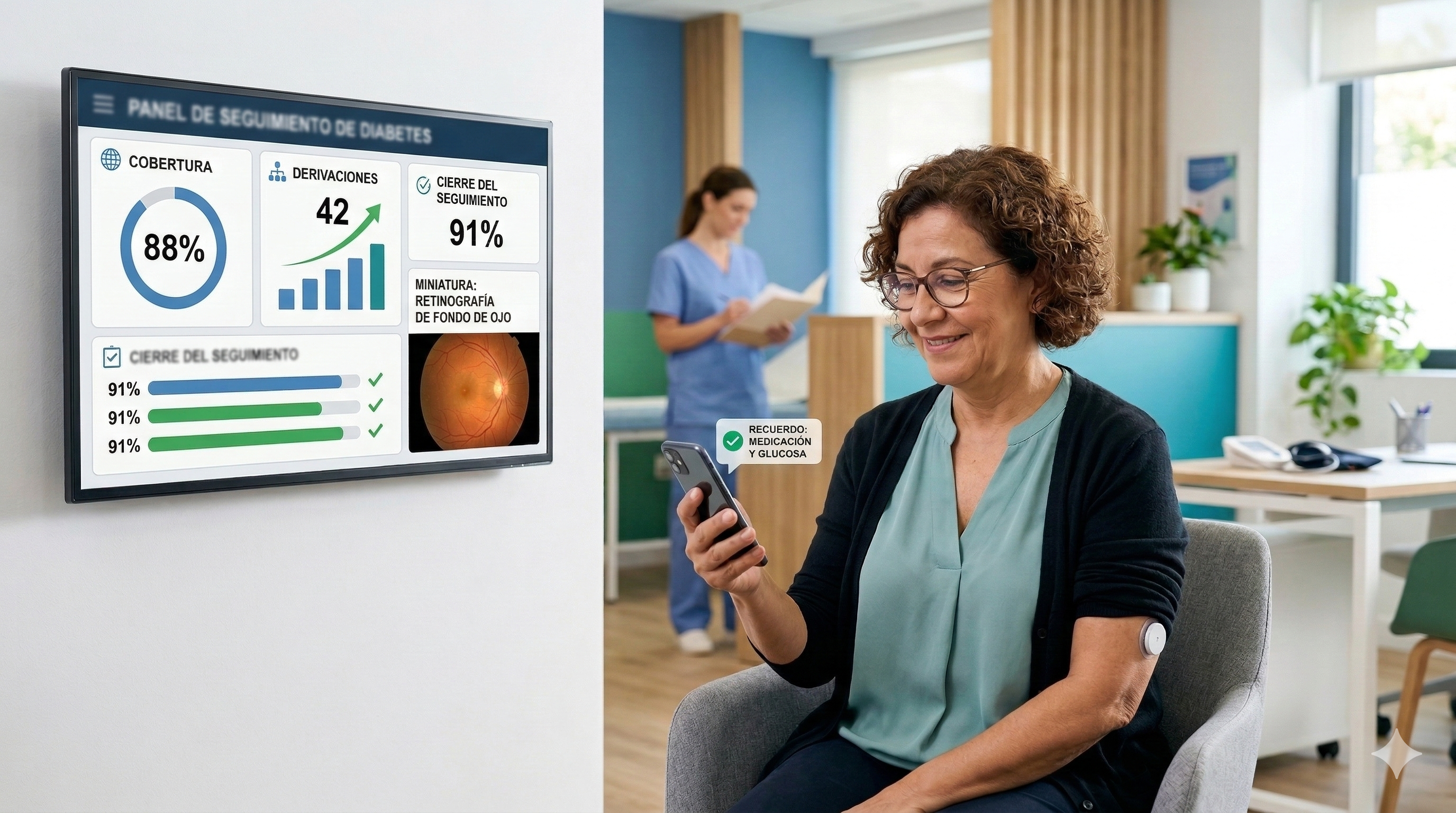
In diabetes care, diabetic retinopathy often progresses without symptoms for years. That is why the most common problem is not “lack of treatment,” but lack of timely follow-up: patients who do not complete annual fundus screening, or who are lost after a high-risk result.
This article is a practical guide for teams in: - Ophthalmology and retina - Internal medicine/diabetology - Hospital and clinic operations - Health insurers/payers - Systems and innovation
Goal: increase adherence and close referrals without saturating specialist capacity.
Clinical recommendations for frequency and criteria:
- ADA Standards of Care - Retinopathy (updated annually): https://diabetesjournals.org/care/article/49/Supplement_1/S261/163919/12-Retinopathy-Neuropathy-and-Foot-Care-Standards
- AAO Preferred Practice Pattern - Diabetic Retinopathy: https://www.aao.org/education/preferred-practice-pattern/diabetic-retinopathy-ppp
- Practical summary (EyeWiki): https://eyewiki.org/Diabetic_Retinopathy_Screening
1) The real funnel: where patients are lost
In practice, loss happens at 3 points:
1) Before screening (not scheduled / no-show)
2) After screening (result is available but no one acts on it)
3) At referral (specialist follow-up is indicated, but appointment is never completed)
The solution is not a single “you are due” reminder. It is a workflow with clear ownership and measurement.
2) Reminders that work: what evidence says (and how to apply it pragmatically)
Evidence shows that SMS/messaging reminders can increase attendance for appointments and follow-up in healthcare. A Cochrane review found that text messaging improves attendance compared with no reminders or postal reminders, with low-to-moderate quality evidence (but consistent direction) and low cost.
Source: https://www.cochrane.org/evidence/CD007458_mobile-phone-messaging-reminders-attendance-healthcare-appointments
In retina/diabetes programs, studies also report improved screening attendance with SMS reminders. For example:
- Koshy et al. (2008) describes the cost-effectiveness potential of SMS to reduce no-shows in retina screening: https://pmc.ncbi.nlm.nih.gov/articles/PMC2438329/
- Chen et al. (2018) reports improved attendance using informative SMS reminders in rural clinics: https://www.sciencedirect.com/science/article/abs/pii/S0002939418303878
Simple rules so reminders do not become spam
- Short message + explicit action: “Your annual retina screening is pending. Book now / attend on date / reply 1 to coordinate.”
- Two touches, not ten: one reminder (7-14 days before) + one reinforcement (24-48 h before).
- Minimal personalization: name + location + how to confirm/reschedule.
- Offline alternative: phone call or PHC coordination for patients without mobile messaging access.
3) Risk segmentation: the key to improve adherence without collapsing retina services
Not every patient needs the same urgency. Segmentation helps you: - intensify outreach where clinical benefit is highest, - reduce pressure on ophthalmology for lower-risk cases.
Example operational scheme:
- Red (high priority): referable DR-compatible result / critical finding / repeated “ungradable”
- target: confirmed appointment within 7-14 days (or sooner per clinical protocol).
- Yellow (medium priority): mild/moderate changes without urgent criteria
- target: appointment or follow-up in 30-90 days.
- Green (lower risk): annual follow-up planned
- target: ensure next screening happens without friction.
This aligns with triage logic to avoid service saturation, also covered in:
/en/blog/teleophthalmology-implementation-models-hospitals-clinics-campaigns/
4) “Loop closure”: the metric that separates real programs from endless pilots
Coverage matters. But in diabetes care, outcomes improve when referrals are actually completed.
Minimum monthly dashboard metrics
1) Coverage: eligible vs screened
2) % gradable studies: gradable/ungradable images (and causes)
3) Time to result: capture -> pre-triage -> report (SLA)
4) Referral rate: % requiring specialist follow-up
5) Loop closure: % referred who were actually seen
6) Time to effective appointment: referred -> seen
7) Loss to follow-up: not contacted / no-shows / reschedules
8) Quality/Audit: second reads / discordances where applicable
5) Implementation checklist (hospital, clinic, payer)
A) Hospital / public network (PHC + referral center)
- Define who schedules and who confirms appointments.
- Reserve protected slots for red-priority referrals.
- Create a contact pool (PHC / call center / community health workers) to recover no-shows.
- Contingency plan for ungradable studies (fast recapture).
B) Clinic / private network
- Offer screening as a “15-minute service” (capture) + remote report.
- Explicit result SLA (for example 24-72 h by severity).
- Automated reminders + simple rescheduling (without endless phone loops).
C) Health insurer / payer
- Named list: members with diabetes and no fundus screening in 12 months.
- Segmented campaign (green/yellow/red) with different contact intensity.
- Provider agreements and incentives to absorb high-risk referrals.
Useful framework for digital interventions (including targeted communication and reminders):
WHO - Recommendations on Digital Interventions for Health System Strengthening: https://www.who.int/publications/i/item/9789241550505
6) Practical example: how Retinar helps with this challenge
In real programs, Retinar typically contributes in two areas that directly affect adherence and loop closure:
1) Reduce friction on day 0 (useful capture on first attempt)
- Capture quality control and standardization to reduce ungradable studies and unnecessary repeat visits.
2) Prioritization and actionable lists
- A high-risk result can become a priority contact list, with status traceability: pending -> contacted -> appointment confirmed -> attended.
- This list can integrate into local operations (scheduling, call center, PHC), so results do not remain trapped in a PDF or an unowned inbox.
If your organization is also defining how to combine automation with professional review, this framework can help:
/en/blog/human-in-the-loop-ai-in-healthcare/
7) Message templates (ready to use)
Reminder 1 (7-14 days before)
> Hi {Name}. Your annual diabetes retina screening is due. You can complete it at {Location}. Reply “YES” and we will coordinate your appointment, or “CHANGE” to reschedule.
Reminder 2 (24-48 h before)
> Hi {Name}. This is a reminder for your retina screening at {Location} on {Day} at {Time}. If you cannot attend, reply “CHANGE”.
Priority referral (red)
> Hi {Name}. Your retina study requires specialist follow-up. We can prioritize your appointment at {Location}. Reply “YES” and we will call you today.
Closing
If your diabetes retina program is not improving despite “having technology,” review this: clear scheduling ownership + risk segmentation + loop-closure dashboard. With those three elements, reminders stop being isolated messages and become measurable operations.
If useful, we can run a technical-clinical demo and build a phased plan (capture, triage, referral, follow-up) adapted to your hospital, clinic, or payer with metrics from month one. Contact us through retinar.com.ar.