
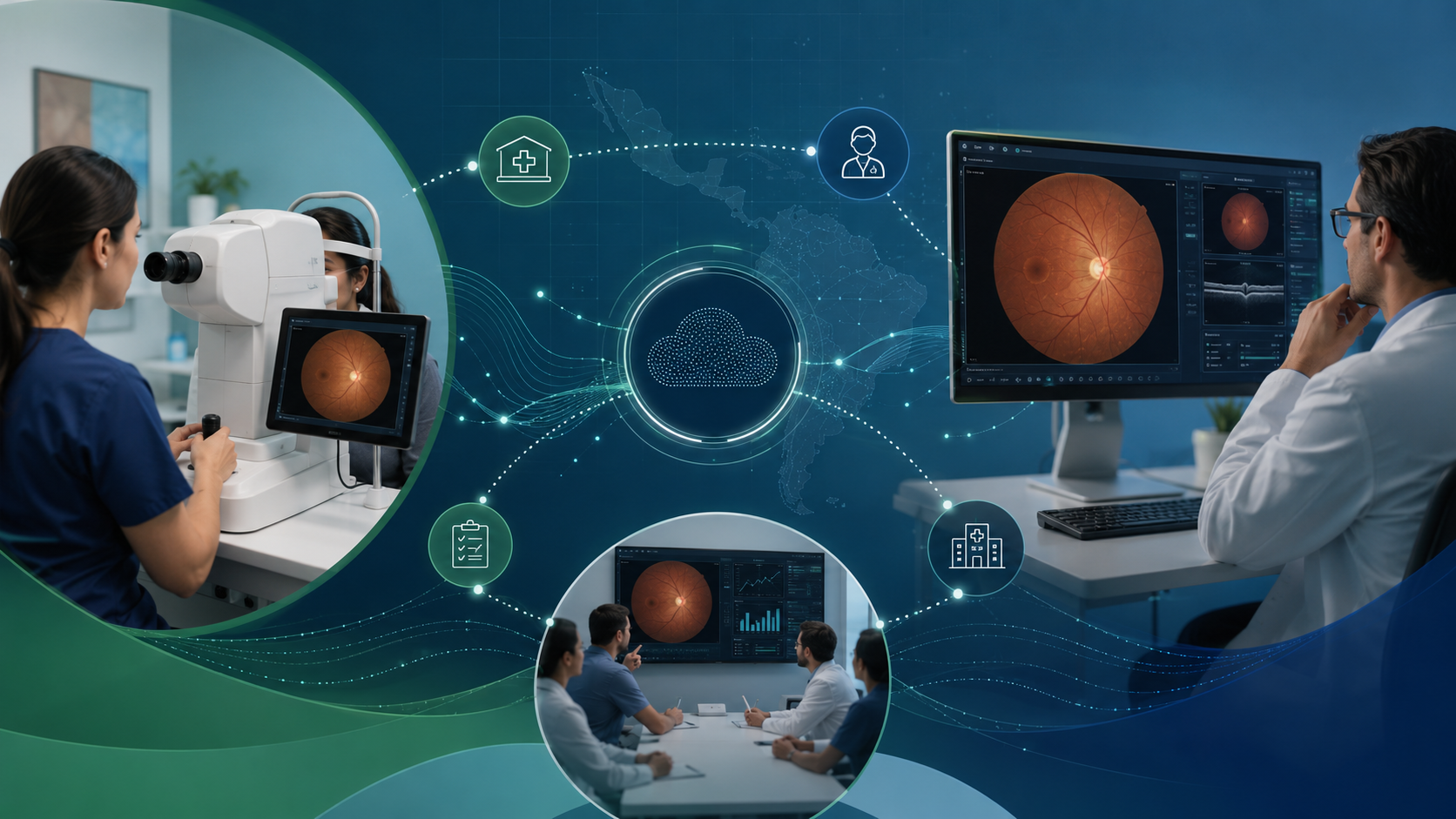
When people talk about teleophthalmology with artificial intelligence, the conversation often gets stuck on the same question: “Does the AI diagnose on its own?” But for institutions trying to expand access to eye care, that is not the most useful question.
The relevant question is different: how can AI and remote reading help the workflow operate better without compromising clinical safety?
In that context, AI should not be understood as a replacement for the ophthalmologist or as an isolated product. Its value appears when it is integrated into a workflow of capture, quality control, prioritization, reading, referral, and follow-up.
The underlying problem is not the lack of images
Many networks can capture studies, but they do not always process them with enough speed and consistency. That creates bottlenecks such as:
- studies waiting too long to be reviewed
- low-quality images that require recapture
- specialists receiving large volumes without prioritization
- weak traceability between capture, reporting, and referral
The consequence is not only operational. It also affects access and timeliness.
What AI can add when it is integrated well
AI can be useful as a support layer in several parts of the workflow, for example:
- flagging image-quality problems
- helping identify studies that should be reviewed sooner
- standardizing part of the pre-triage process
- organizing work so specialists intervene where they add the most value
None of that removes the need for human oversight. In fact, mature clinical AI implementation requires a clear definition of what the system does, what the team does, and how each decision is documented.
From isolated app to clinical infrastructure
An institution gets much more value when it stops treating AI as a one-off demo and starts treating it as part of its digital health infrastructure.
That means making at least four decisions:
1. Where it fits into the workflow
AI may support capture, quality control, prioritization, or assisted reading. But not every institution needs the exact same configuration.
2. Which operational goal it serves
It is not the same to aim for:
- broader territorial coverage
- shorter response times
- lower reading backlog
- more consistent pre-triage
- distributed operation across multiple devices or sites
Defining the problem first avoids implementing technology without clear impact.
3. How risk is governed
If AI is part of a clinical workflow, teams should make explicit:
- which outputs are used for prioritization
- when a study requires mandatory human review
- how ungradable or ambiguous studies are handled
- how real-world performance is audited in operation
This connects directly with the human-in-the-loop approach we explored in AI in healthcare: what human in the loop means in practice.
4. How it connects to existing systems
If the tool remains disconnected from the medical record, the operating log, or the referral pathway, teams end up duplicating work. That is why interoperability matters as much as the algorithm. We addressed that in Interoperability in teleophthalmology: integrating fundus imaging with HL7 FHIR and DICOM.
Which institutions can benefit the most
Teleophthalmology with AI is especially useful when there is:
- growing demand for retinal checks
- limited specialist teams concentrated in a few hubs
- a need to capture in the field and review elsewhere
- interest in better case prioritization
That applies to hospitals, clinics, diabetes programs, and public or private networks with multiple care points.
What should not be promised
A common mistake in clinical AI messaging is presenting it as if it solved a complex problem on its own. In practice, institutions should avoid promising:
- automatic diagnosis without validation
- replacement of the ophthalmologist
- guaranteed impact without operational redesign
- easy adoption without training, metrics, and governance
The stronger message is more concrete: use AI to make the workflow more operational, improve prioritization, and sustain coverage with human review.
How Retinar approaches it
At Retinar, we treat teleophthalmology with AI as clinical infrastructure that can be integrated into different care models.
That includes:
- decentralized capture focused on real image usability
- support for image quality control
- pre-triage to prioritize higher-risk cases
- remote reading and reporting with human supervision
- traceability and interoperability with other systems when needed
Conclusion
Teleophthalmology with artificial intelligence can expand access to eye care, but its value is not “AI by itself.” Its value lies in how it fits into a safe, measurable, and sustainable care workflow.
If your institution is evaluating how to add this capability without turning it into a disconnected technology island, contact us to design a phased implementation model.